

dgjreival.com | contact@dgjrevival.com | (980) 428-9647
Facebook | Instagram | YouTube | Spotify | DGJ Store


Fabbri
by John F. Milius
From the pages of the Double Gun Journal. Volume 9, Issue 2 - Summer 1998
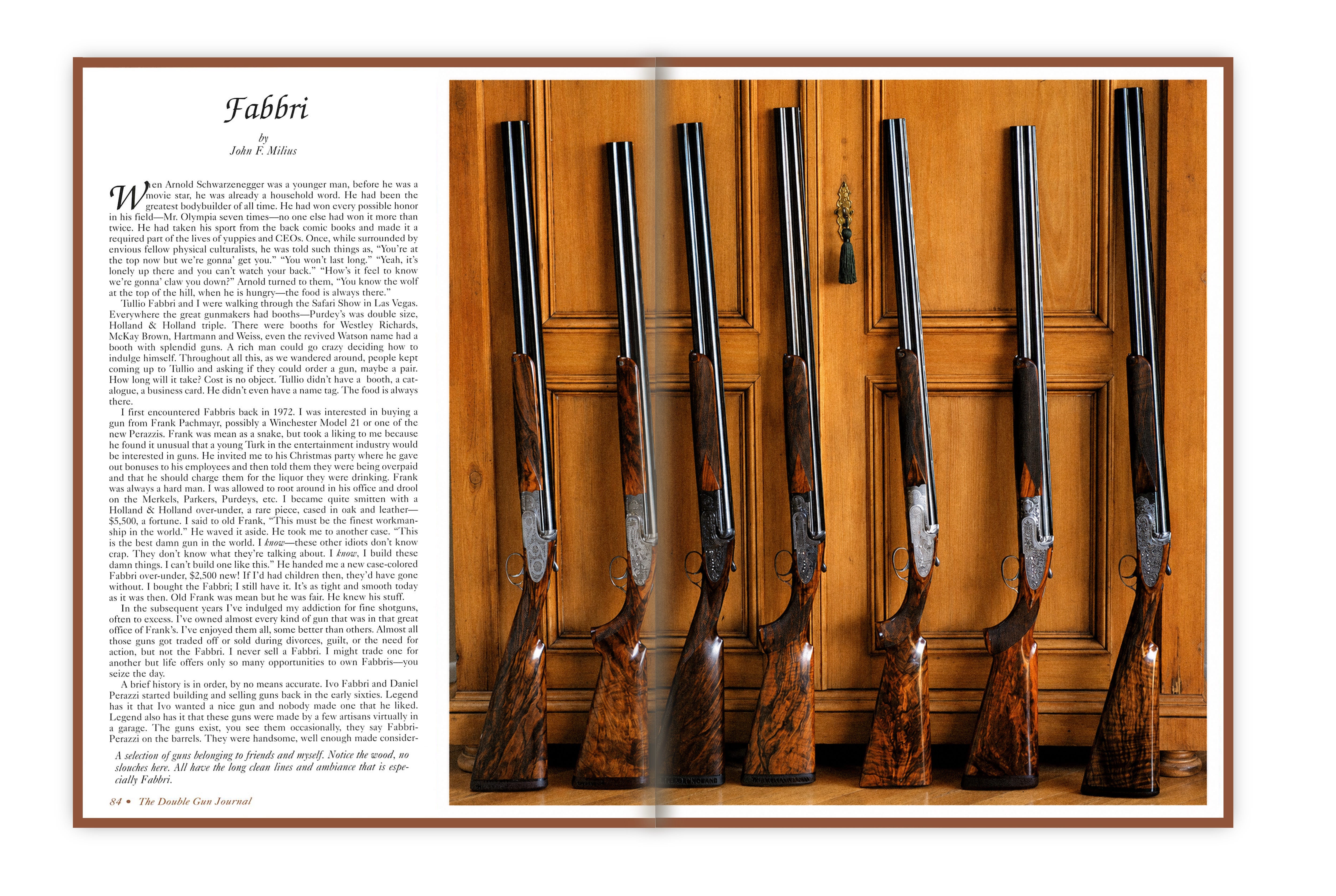
When Arnold Schwarzenegger was a younger man, before he was a movie star, he was already a household word. He had been the greatest bodybuilder of all time. He had won every possible honor in his field—Mr. Olympia seven times—no one else had won it more than twice. He had taken his sport from the back of comic books and made it a required part of the lives of yuppies and CEOs. Once, while surrounded by envious fellow physical culturalists, he was told such things as, “You’re at the top now but we’re gonna’ get you.” “You won’t last long.” “Yeah, it’s lonely up there and you can’t watch your back.” “How’s it feel to know we’re gonna’ claw you down?” Arnold turned to them, “You know the wolf at the top of the hill, when he is hungry—the food is always there.”
Tullio Fabbri and I were walking through the Safari Show in Las Vegas. Everywhere the great gunmakers had booths—Purdey’s was double size, Holland & Holland triple. There were booths for Westley Richards, McKay Brown, Hartmann and Weiss, even the revived Watson name had a booth with splendid guns. A rich man could go crazy deciding how to indulge himself. Throughout all this, as we wandered around, people kept coming up to Tullio and asking if they could order a gun, maybe a pair. How long will it take? Cost is no object. Tullio didn’t have a booth, a catalogue, a business card. He didn’t even have a name tag. The food is always there.
I first encountered Fabbris back in 1972. I was interested in buying a gun from Frank Pachmayr, possibly a Winchester Model 21 or one of the new Perazzis. Frank was mean as a snake, but took a liking to me because he found it unusual that a young Turk in the entertainment industry would be interested in guns. He invited me to his Christmas party where he gave out bonuses to his employees and then told them they were being overpaid and that he should charge them for the liquor they were drinking. Frank was always a hard man. I was allowed to root around in his office and drool on the Merkels, Parkers, Purdeys, etc. I became quite smitten with a Holland & Holland over-under, a rare piece, cased in oak and leather—$5,500, a fortune. I said to old Frank, “This must be the finest workmanship in the world.” He waved it aside. He took me to another case. “This is the best damn gun in the world. I know—these other idiots don’t know crap. They don’t know what they’re talking about. I know, I build these damn things. I can’t build one like this.” He handed me a new case-colored Fabbri over-under, $2,500 new! If I’d had children then, they’d have gone without. I bought the Fabbri; I still have it. It’s as tight and smooth today as it was then. Old Frank was mean but he was fair. He knew his stuff.
In the subsequent years I’ve indulged my addiction for fine shotguns, often to excess. I’ve owned almost every kind of gun that was in that great office of Frank’s. I’ve enjoyed them all, some better than others. Almost all those guns got traded off or sold during divorces, guilt, or the need for action, but not the Fabbri. I never sell a Fabbri. I might trade one for another but life offers only so many opportunities to own Fabbris—you seize the day.


